Pit Firing Workshop March 2022
Pit firing, the earliest known method of firing pottery dating back to 29,000 - 25,000 BCE (the earliest surviving kiln dates to 6,000 BCE at the Yarim Tepe site in Iraq). Today kilns are the means of firing, but studio potters and potters predominantly in African countries still pit fire.
The process is simple: a pit is dug, the dried and unfired pots are safely placed inside and surrounded by combustible materials (wood, shavings, dried manure, leaves, and sometimes metal oxides and salts), the fire is built on top and allowed to burn down into the pots until the inner fuel is consumed and a top temperature of about 2,000F/1,100C is reached, then smothered and cooled until extraction. This produced earthenware pottery, a nonvitreous pottery (not food safe).
My workshop focused on coil building and paddle shaping with an anvil, or a bisqued tear drop shaped clay tool still used today by many potters in Africa. The coils of clay are built up and the anvil is held on the inside of the pot and paddled from the outside to compress the clay and help form the profile. Another aspect of the workshop was to create your own terra sigillata ("sealed earth" in latin, fine slip buffed to create a more non-porous surface before modern glazes) and apply it to your pot. I used a local red terra sigillata and a more yellow sample taken from my parent's back yard for brush detailing.
For safety and success rate, all pieces were pre-bisqued before pit firing. Our firing was a success and all but one test piece survived the process.

Large pot, front.

Large pot, back.

Large pot, neck and mouth detail.

Large pot, decorative handle detail.

Large pot, foot detail.

Small bowl.

Small bowl, inside.

Small bowl, carbon on harvested terra sigillata detail.

Large pot, base started.

Large pot, inside the base.

Large pot progress.

Large pot, reaching the height to start curving the shoulder in.

Large pot, finished.

Large pot, top detailing.

Harvested terra sigillata.

Applying terra sigillatta.

Large pot, buffed terra sigillata.

Large pot, harvested terra sigillata detailing applied.

Harvested terra sigillata on test bowl.

All class pots completed and bisqued, ready for pit firing.

Large pot, ready for pit firing.

The pit.

Loading the pots.

Firing.

Smothering for reduction and cooling.

Unearthing.
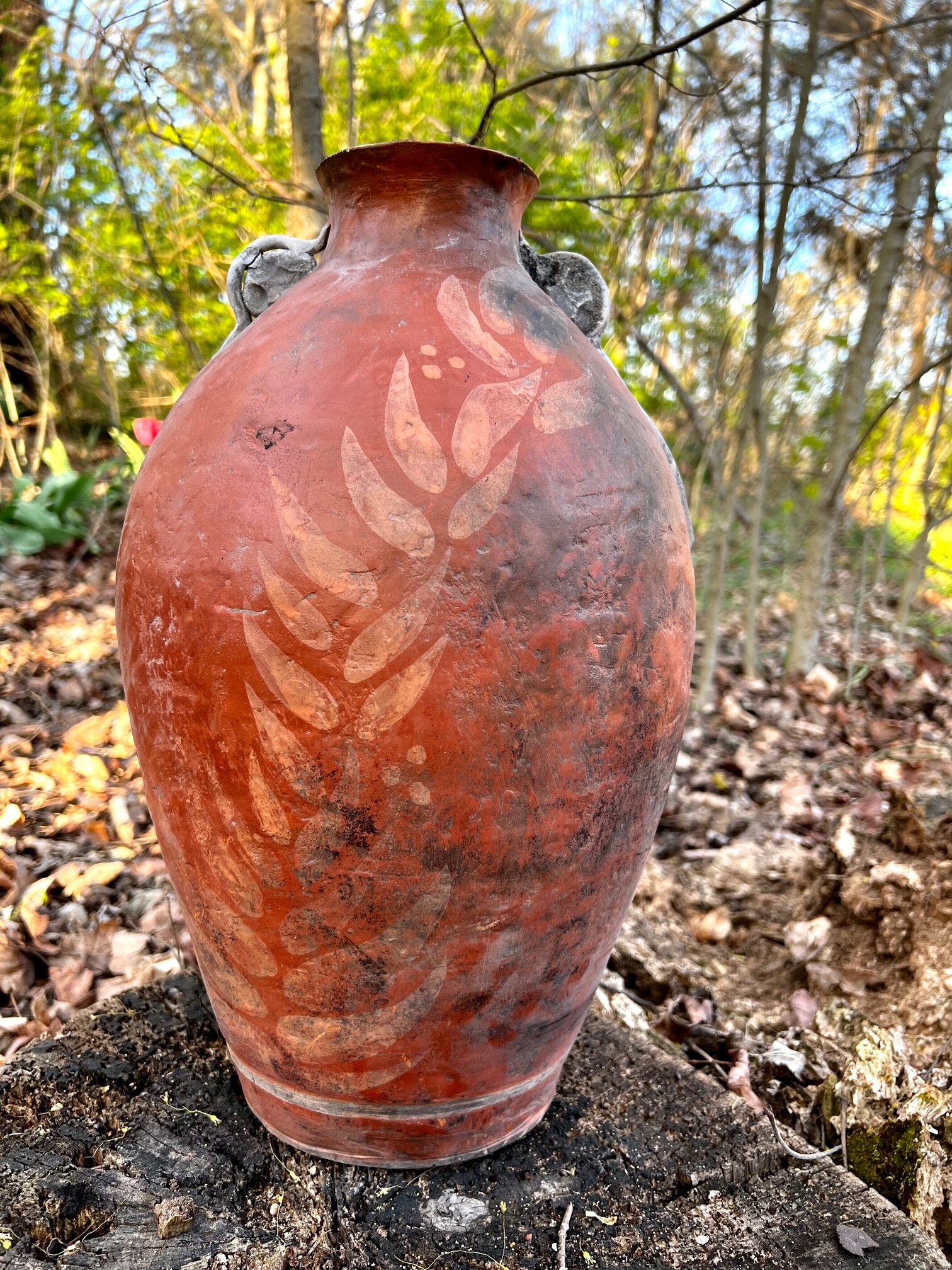
Large pot, completed.

Bowl with harvested terra sigillata, completed.